

GPS Technology in 2026: How Global Positioning Systems Are Revolutionizing Navigation, Business & Everyday Life
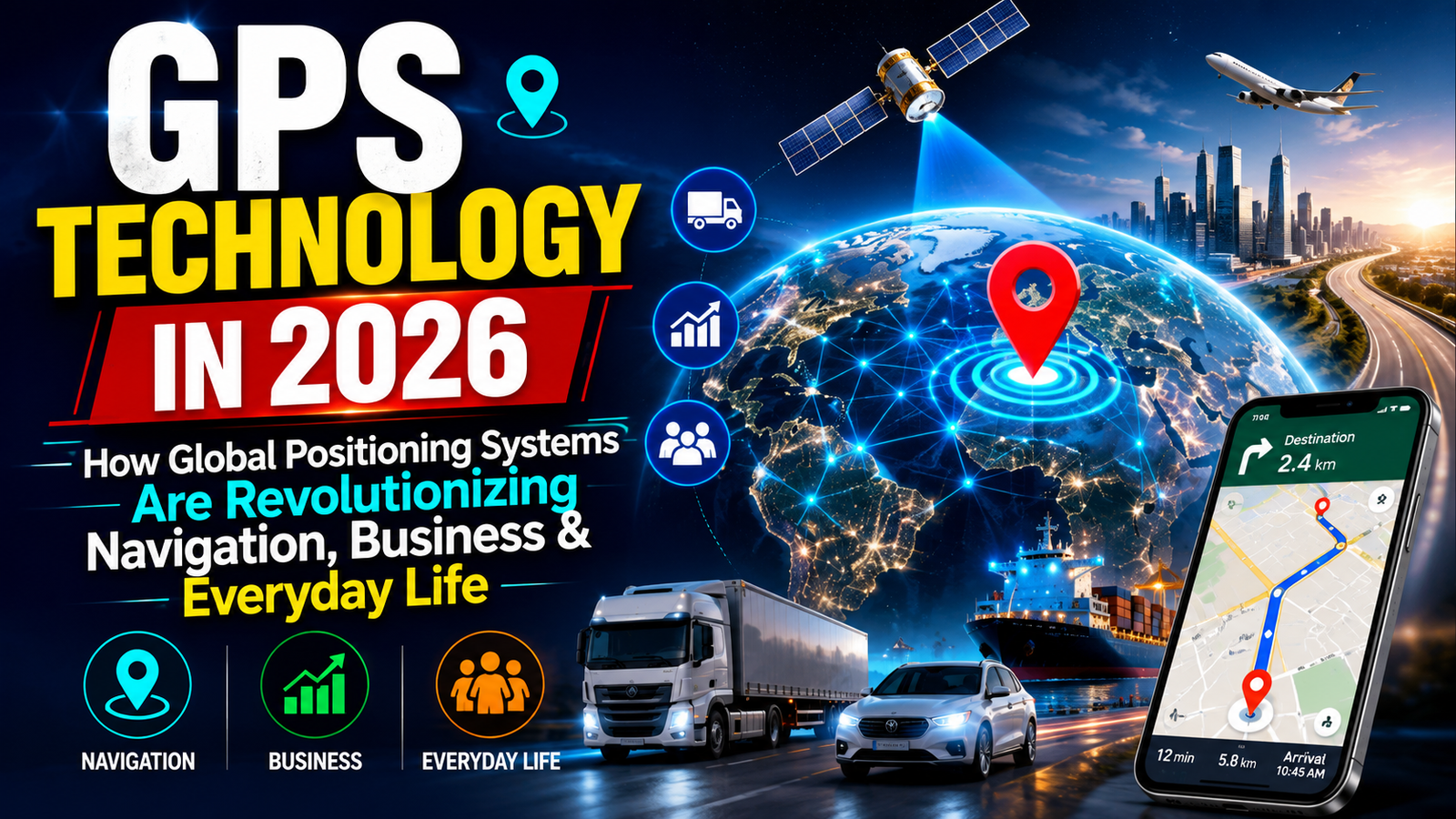
Few technologies have transformed human civilization as profoundly and quietly as the Global Positioning System (GPS). From guiding drivers through unfamiliar cities and tracking cargo shipments across oceans to enabling precision farming, powering emergency rescue operations, and synchronizing global financial networks — GPS technology has become the invisible backbone of modern life. In 2026, GPS is evolving faster than ever, delivering capabilities that would have seemed like science fiction just a decade ago. This GPS technology 2026 guide explores everything you need to know about this remarkable system and the extraordinary ways it is reshaping communications, navigation, business, and everyday living.
🛰️ What Is GPS and How Does It Work?
The Global Positioning System (GPS) is a satellite-based radio navigation system owned and operated by the United States Space Force. It consists of a constellation of at least 24 operational satellites orbiting Earth at approximately 20,200 kilometers altitude, continuously broadcasting precise time and position signals.
GPS receivers — built into mobile phones, dedicated navigation devices, vehicles, wearables, and countless other electronic gadgets — calculate their precise location by measuring the time it takes for signals from at least four satellites to arrive. Using a mathematical process called trilateration, the receiver determines its exact latitude, longitude, altitude, and velocity with remarkable precision.
In 2026, modernized GPS signals offer civilian users positional accuracy to within 30 centimeters or better under optimal conditions — a dramatic improvement from the 5-10 meter accuracy of earlier generations. Augmentation systems including WAAS (Wide Area Augmentation System) and RTK (Real-Time Kinematic) corrections push precision even further for specialized applications.
🗺️ GPS Navigation: From Car Dashboards to Smart Wearables
GPS navigation has evolved far beyond the turn-by-turn dashboard systems of the early 2000s. In 2026, GPS powers a vast ecosystem of navigation solutions:
Smartphone Navigation The integration of GPS into mobile phones has made standalone navigation devices largely obsolete for everyday users. Apps like Google Maps, Apple Maps, and Waze use GPS alongside cellular data, crowdsourced traffic information, and AI prediction to deliver real-time, dynamic navigation that reroutes around accidents and congestion instantly.
In-Vehicle Navigation Systems Modern vehicles feature deeply integrated GPS navigation systems connected to onboard computers, real-time traffic services, and advanced driver assistance systems (ADAS). In 2026, autonomous and semi-autonomous vehicles rely on GPS alongside LiDAR and camera systems for safe, precise positioning.
Wearable GPS Smartwatches, fitness trackers, running watches, and outdoor adventure computers incorporate GPS for activity tracking, navigation, and safety features. Hikers, cyclists, runners, sailors, and outdoors enthusiasts rely on wearable GPS to navigate remote terrain safely.
Aviation & Maritime GPS GPS is indispensable in aviation for approach guidance, en route navigation, and precision landing systems. Maritime applications include vessel tracking, harbor navigation,
and fishing fleet management — revolutionizing safety and efficiency at sea.
🚛 Business Applications of GPS in 2026
The business applications of GPS technology are extraordinarily diverse and continue to expand rapidly:
Fleet Management & Logistics Real-time GPS tracking of delivery vehicles, trucks, and logistics fleets has transformed supply chain management. Fleet operators monitor vehicle location, speed, fuel consumption, driver behavior, and route efficiency continuously — reducing costs, improving safety,
and enhancing customer service.
Precision Agriculture GPS-guided tractors, planters, and harvesters operate with centimeter-level precision, reducing overlap, minimizing input waste, and maximizing crop yields. Precision agriculture powered by GPS is one of the most transformative energy and resource efficiency technologies in modern farming.
Construction & Surveying GPS machine control systems guide grading equipment to precise elevation specifications, dramatically improving construction accuracy and efficiency. Surveyors use GPS to establish property boundaries and topographic maps far faster than traditional methods.
Emergency Services First responders, ambulances, fire departments, and search-and-rescue teams use GPS for dispatch optimization, responder location tracking, and precise incident positioning — saving lives through faster, better-coordinated emergency response.
Asset Tracking High-value electronic gadgets, equipment, containers, and assets are fitted with GPS tracking devices, allowing businesses to monitor location and movement in real time — dramatically reducing theft and loss.
Timing & Synchronization Financial markets, telecommunications networks, power grids, and data centers rely on GPS-synchronized timing to coordinate transactions, network operations,
and communications with nanosecond precision.
🌍 Global Navigation Satellite Systems Beyond GPS
GPS is the most widely known satellite navigation system, but it is not the only one. In 2026, multiple global and regional systems operate alongside GPS:
GLONASS (Russia) Russia’s Global Navigation Satellite System provides global coverage and is commonly used alongside GPS in modern receivers for enhanced accuracy and reliability.
Galileo (European Union) The EU’s Galileo system offers civilian users high-accuracy positioning with enhanced safety-of-life services and encrypted government signals.
BeiDou (China) China’s BeiDou Navigation Satellite System has achieved global coverage and is now the largest satellite navigation constellation by number of satellites.
NavIC (India) India’s regional navigation system provides precise positioning across the Indian subcontinent and surrounding regions.
Modern GPS receivers — including those in mobile phones and personal tech devices — typically receive signals from multiple systems simultaneously,
dramatically improving accuracy, availability, and reliability.
🔒 GPS Security & Privacy Considerations
As GPS becomes ever more deeply integrated into daily life, security and privacy concerns are growing:
GPS Spoofing — Malicious actors can broadcast false GPS signals to deceive receivers into displaying incorrect locations. This threat to aviation, maritime,
and critical infrastructure navigation is a serious security concern in 2026.
GPS Jamming — Radio frequency interference can disrupt GPS signals in targeted areas. Military conflicts and criminal activities increasingly involve GPS jamming as a tactical tool.
Location Privacy — The continuous GPS tracking capabilities of mobile phones and connected devices raise profound personal privacy concerns. In 2026, cyber law frameworks and government service regulations around location data are evolving rapidly.
Cybersecurity — GPS-dependent systems including financial networks, power grids, and communications infrastructure represent critical vulnerabilities that demand robust security protections.
🔮 The Future of GPS Technology
The GPS technology roadmap for 2026 and beyond is extraordinarily exciting:
GPS III Satellites — Next-generation GPS III satellites provide three times better accuracy, eight times improved anti-jamming capability, and significantly enhanced signal strength.
Multi-Frequency Signals — New civilian GPS signals on multiple frequencies enable centimeter-level accuracy for mainstream consumer applications.
Integration with AI — Artificial intelligence is being integrated with GPS data to enable predictive navigation, anomaly detection, and autonomous system coordination.
Indoor Positioning — Combining GPS with WiFi, Bluetooth, and ultra-wideband (UWB) technologies enables precise positioning inside buildings where satellite signals cannot penetrate.
5G & GPS Integration — The rollout of 5G communications networks is creating powerful synergies with GPS, enabling new location-based services with unprecedented speed and precision.
🏁 Conclusion
GPS technology in 2026 is far more than a navigation tool — it is fundamental infrastructure upon which modern civilization depends. From guiding your daily commute and enabling life-saving emergency responses to powering global communications networks and transforming precision agriculture,
GPS touches virtually every dimension of human activity. As this technology continues to evolve with greater precision, security, and integration,
its role in shaping our world will only deepen. Understanding and leveraging GPS technology 2026 is not just useful — it is essential for anyone operating in today’s connected, location-aware world.