
Copywriting in 2026: The Ultimate Guide to Writing Words That Sell, Persuade & Convert
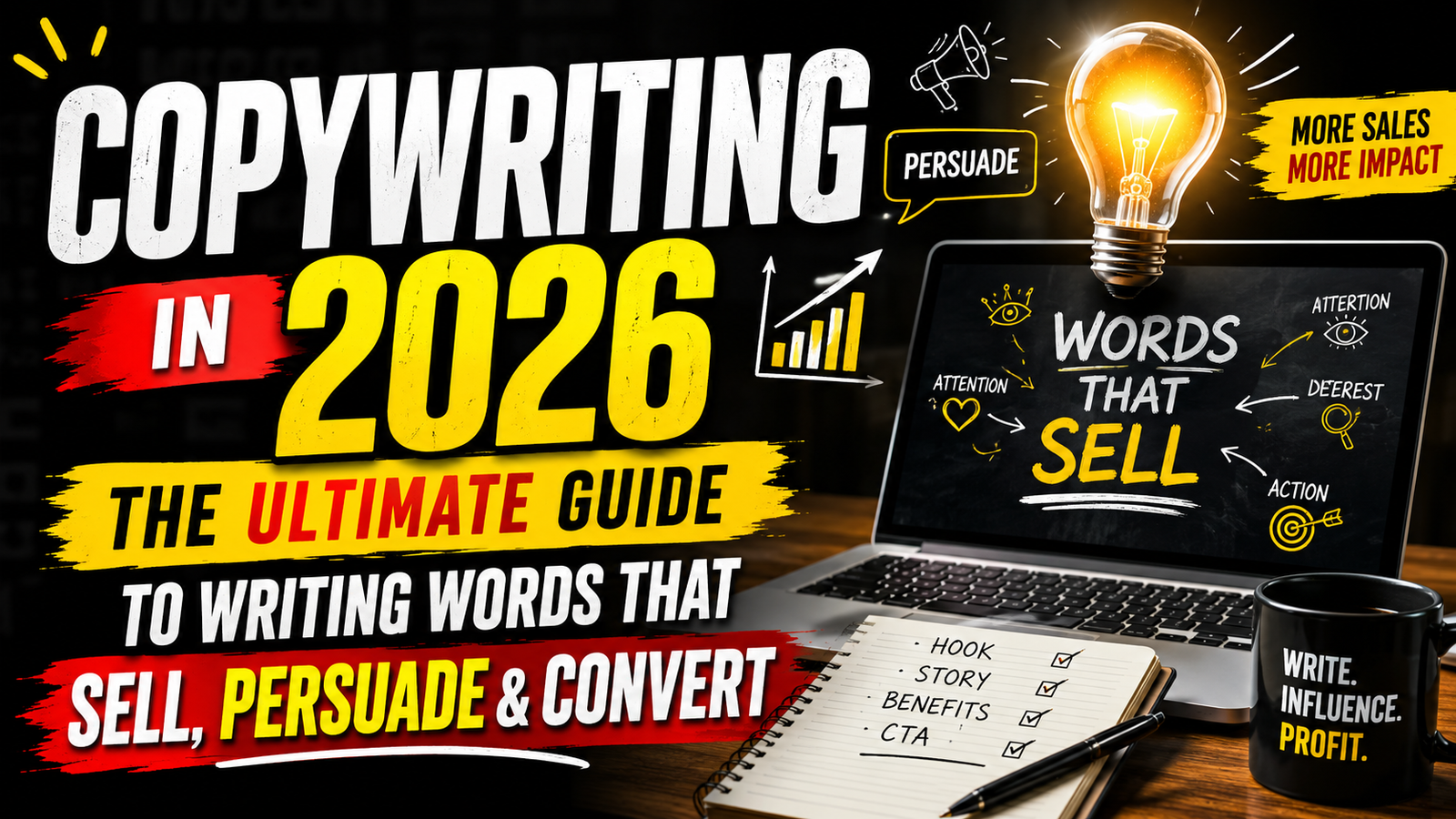
Copywriting is the art and science of using words strategically to persuade readers to take a specific action — whether that is making a purchase, subscribing to a newsletter, downloading a resource, or picking up the phone. In 2026, copywriting has become one of the most valuable and sought-after skills in the digital economy. As content marketing matures, ecommerce competition intensifies, and attention spans shorten, the ability to write compelling, conversion-focused copy has never been more commercially powerful. This copywriting guide 2026 covers everything you need to write words that genuinely move people — and move products, services, and ideas into the world.
📖 What Is Copywriting and Why Does It Matter?
Copywriting is fundamentally different from content writing. While content marketing writing aims to educate, inform, and build authority over time, copywriting has one singular purpose: persuasion leading to action. Every word in great copywriting is chosen with intentional strategic purpose.
Copywriting appears across every touchpoint of the customer journey:
- Sales pages and landing pages
- Email marketing sequences and newsletters
- PPC advertising and display ads
- Product descriptions for ecommerce stores
- Social media ad copy and organic posts
- Video scripts and screenwriting for commercials
- Direct mail letters and brochures
- Website home pages and about pages
- Ebook writing and lead magnet content
In 2026, businesses that invest in skilled copywriting consistently outperform competitors across every measurable metric — including conversion rates, email marketing open rates, ad click-through rates, and revenue per visitor.
🧠 The Psychology Behind Effective Copywriting
The most powerful copywriting is rooted in deep psychological understanding of human motivation, decision-making, and behavior. Master these principles and your copywriting becomes exponentially more persuasive:
The Problem-Agitate-Solution Framework The foundational structure of persuasive copywriting: identify your reader’s most painful problem, agitate it by exploring its consequences and emotional weight, then present your offer as the perfect solution. This framework appears in virtually every successful sales page and email marketing sequence.
Social Proof Humans are profoundly influenced by the choices and opinions of others. Testimonials, case studies, user numbers, media mentions, and expert endorsements are the most powerful copywriting elements available — they dramatically reduce skepticism and accelerate purchase decisions.
Scarcity and Urgency Limited time offers, limited stock notifications, and deadline-driven calls to action tap into the powerful human fear of missing out. Used authentically and ethically, scarcity and urgency are among the most effective copywriting conversion tools.
The Rule of One Great copywriting speaks to one reader, about one big idea, making one clear offer, with one specific call to action. Trying to communicate multiple messages simultaneously dilutes impact and confuses readers into inaction.
Specificity Builds Credibility Vague claims destroy copywriting effectiveness. Specific claims — exact numbers, precise results, concrete details — build credibility and make your copywriting dramatically more believable and compelling.
Emotional Before Rational People make decisions emotionally and justify them rationally. Effective copywriting connects with emotional desires, fears, and aspirations first — then provides rational justification through features, specifications, and data.
🏆 The Anatomy of a Perfect Sales Page
A high-converting sales page — the pinnacle of copywriting craft — follows a proven structural formula:
Headline — Your most critical copywriting element. A great headline immediately communicates the biggest benefit or most compelling promise to your specific reader. Spend disproportionate time crafting and testing headlines.
Subheadline — Expands on the headline promise, providing additional context and deepening reader interest.
Opening Hook — The first paragraph must immediately address the reader’s core pain point or desire with visceral specificity that makes them feel genuinely understood.
Story & Identification — Great copywriting uses narrative to build emotional connection. Share a relatable story — yours, a customer’s, or a carefully constructed scenario — that mirrors the reader’s experience.
Benefits Over Features — Features describe what your product is; benefits explain what it does for the reader. Powerful copywriting always leads with benefits, using features as supporting evidence.
Social Proof — Weave testimonials, case studies, and credibility indicators throughout the sales page to continuously reinforce trust.
Objection Handling — Proactively identify and address every reservation a skeptical buyer might have. Copywriting that acknowledges and dissolves objections converts dramatically better than copy that ignores them.
Guarantee — A strong, specific guarantee removes purchase risk and dramatically increases conversion rates. Make your guarantee as bold and specific as your offer legitimately allows.
Call to Action — Tell readers exactly what to do next with clear, specific, benefit-oriented language. Never assume readers know what action to take — tell them explicitly and make it easy.
P.S. — The postscript of a sales letter or email is statistically among the most-read sections of any copywriting piece. Use it to restate the core offer, reinforce urgency, or repeat the guarantee.
📧 Email Copywriting Mastery in 2026
Email marketing remains the highest-ROI digital channel available, and brilliant copywriting is the engine driving its effectiveness. In 2026, email marketing copywriting best practices include:
Subject Lines Make or Break Everything Your email marketing subject line is pure copywriting — its only job is to earn an open. Use curiosity, specificity, personalization, numbers, and conversational tone to maximize open rates. Test relentlessly.
Write Like a Person, Not a Brand The most effective email marketing copywriting feels like a personal letter from a trusted friend, not a corporate communication. Use first-person singular, conversational language, and genuine personality.
One Email, One Goal Every email marketing message should pursue one specific objective — drive a click, generate a reply, or make a sale. Multiple goals in a single email dilute effectiveness dramatically.
Tell Stories Narrative is the most powerful copywriting tool in email marketing. Short, relatable stories that connect to your offer outperform feature-list-heavy copy every time.
Strong CTAs Every email marketing message needs a clear, compelling call to action with benefit-oriented language — never just “Click Here” or “Buy Now.”
🔍 SEO Copywriting in 2026
SEO copywriting merges the persuasive power of traditional copywriting with the discoverability of search engine marketing. In 2026, effective SEO copywriting requires:
Keyword Research Integration — Begin every SEO copywriting project with thorough keyword research. Identify the primary and secondary terms your audience uses, then weave them naturally into compelling, reader-first prose.
Search Intent Alignment — Match your copywriting precisely to what searchers actually want when they type a given query — informational, navigational, commercial, or transactional intent.
Compelling Meta Descriptions — Meta descriptions are pure copywriting — mini ads for your page in search results. Write them to earn clicks, not just describe content.
Headers as Scannable Hooks — Readers scan before they read. Use H2 and H3 headers as copywriting opportunities to grab attention and communicate value across every section.
🤖 AI & Copywriting in 2026
Artificial intelligence has fundamentally transformed the copywriting landscape. Smart copywriting professionals in 2026 leverage AI tools as powerful accelerators:
- AI generates first drafts, outlines, and copywriting variations at speed
- Human copywriters elevate AI output with strategic insight, emotional intelligence, and authentic brand voice
- AI enables rapid A/B testing of copywriting variations across email marketing, ads, and landing pages
- The demand for skilled human copywriting has actually increased as AI-generated content floods the market — creating premium value for copy with genuine expertise, perspective, and persuasive craft
📚 Building Your Copywriting Career in 2026
Copywriting offers one of the most lucrative and flexible career paths in the digital economy:
Build a Portfolio — Create copywriting samples across multiple formats — sales pages, email marketing sequences, ad copy, and ecommerce product descriptions — even if initially for fictional brands.
Study the Masters — Read and analyze legendary copywriting from David Ogilvy, Gary Halbert, Eugene Schwartz, and John Caples. Classic writing articles and books on persuasion remain invaluable.
Specialize Strategically — Copywriting specialists in high-value niches — finance, health, ecommerce, and SaaS — command premium rates in 2026.
Network Actively — Connect with marketing agencies, content marketing studios, and direct-response businesses through professional networking platforms and industry communities.
Never Stop Learning — Copywriting mastery is a lifelong pursuit. Study consumer psychology, test your own copy constantly, and analyze what converts in your niche with scientific rigor.
🏁 Conclusion
Copywriting in 2026 is one of the most powerful, financially rewarding, and creatively satisfying skills available to digital professionals. Whether you are writing email marketing sequences that generate millions in revenue, crafting ecommerce product descriptions that make browsers into buyers, or building a freelance copywriting career that delivers extraordinary income and freedom — the fundamental principles of this copywriting guide 2026 will serve you for an entire lifetime. Learn the craft, practice relentlessly, and never underestimate the extraordinary power of the right words in the right order.